RTX 5090 vs RTX PRO 6000 - AI Inference Benchmark Comparison
The RTX 5090 (32 GB GDDR7, $1,999) and the RTX PRO 6000 (96 GB GDDR7, ~$5,000) both use NVIDIA's Blackwell architecture. We ran identical AI inference benchmarks and GPU stress tests on both cards. The result: at 32B parameter models, performance is virtually identical (~69 tok/s). But for 70B+ models, the PRO 6000's 96 GB VRAM is the only option.
Hardware Specifications
| Specification | RTX 5090 | RTX PRO 6000 |
|---|---|---|
| Architecture | Blackwell (Compute 12.0) | Blackwell (Compute 12.0) |
| VRAM | 32 GB GDDR7 | 96 GB GDDR7 |
| Memory Bandwidth | 1,792 GB/s | 1,536 GB/s |
| Streaming Multiprocessors | 170 | 160 |
| TDP | 575W | 600W (350W limited) |
| Price | ~$1,999 | ~$5,000 |
The RTX 5090 actually has higher memory bandwidth (1,792 vs 1,536 GB/s) and more streaming multiprocessors (170 vs 160). On paper, the 5090 is faster per-operation. The PRO 6000's advantage is entirely about 3x the VRAM capacity — 96 GB vs 32 GB.
32B Model Benchmark (llama-bench)
We used llama-bench with Qwen2.5-32B-Instruct-AWQ (Q4_0, 4-bit quantized) — a model that fits in both GPUs' memory.
| Benchmark | RTX 5090 | RTX PRO 6000 | Difference |
|---|---|---|---|
| Prefill pp512 (tok/s) | 11,516 | 12,383 | PRO 6000 +7.5% |
| Prefill pp1024 (tok/s) | 10,556 | 10,419 | 5090 +1.3% |
| Prefill pp2048 (tok/s) | 8,986 | 9,330 | PRO 6000 +3.8% |
| Generation tg128 (tok/s) | 69.83 | 68.37 | 5090 +2.1% |
| Generation tg256 (tok/s) | 69.29 | 67.92 | 5090 +2.0% |
Token generation speed: RTX 5090 at 69.83 tok/s vs PRO 6000 at 68.37 tok/s — a 2% difference that is effectively identical. The 5090's slightly higher memory bandwidth (1,792 vs 1,536 GB/s) gives it a marginal edge in generation, while the PRO 6000 occasionally leads in prefill. For 32B models, these GPUs are interchangeable in terms of raw inference speed.
70B+ Models — PRO 6000 Exclusive Territory
Models above 32B parameters cannot fit in the RTX 5090's 32 GB VRAM, even with 4-bit quantization. The PRO 6000's 96 GB handles them easily.
| Model | RTX PRO 6000 | RTX 5090 |
|---|---|---|
| Llama 3.1 70B-Instruct (Q4_K_M) | 33.75 tok/s | N/A (VRAM) |
| Qwen2.5 72B-Instruct (Q4_K_M) | 30.84 tok/s | N/A (VRAM) |
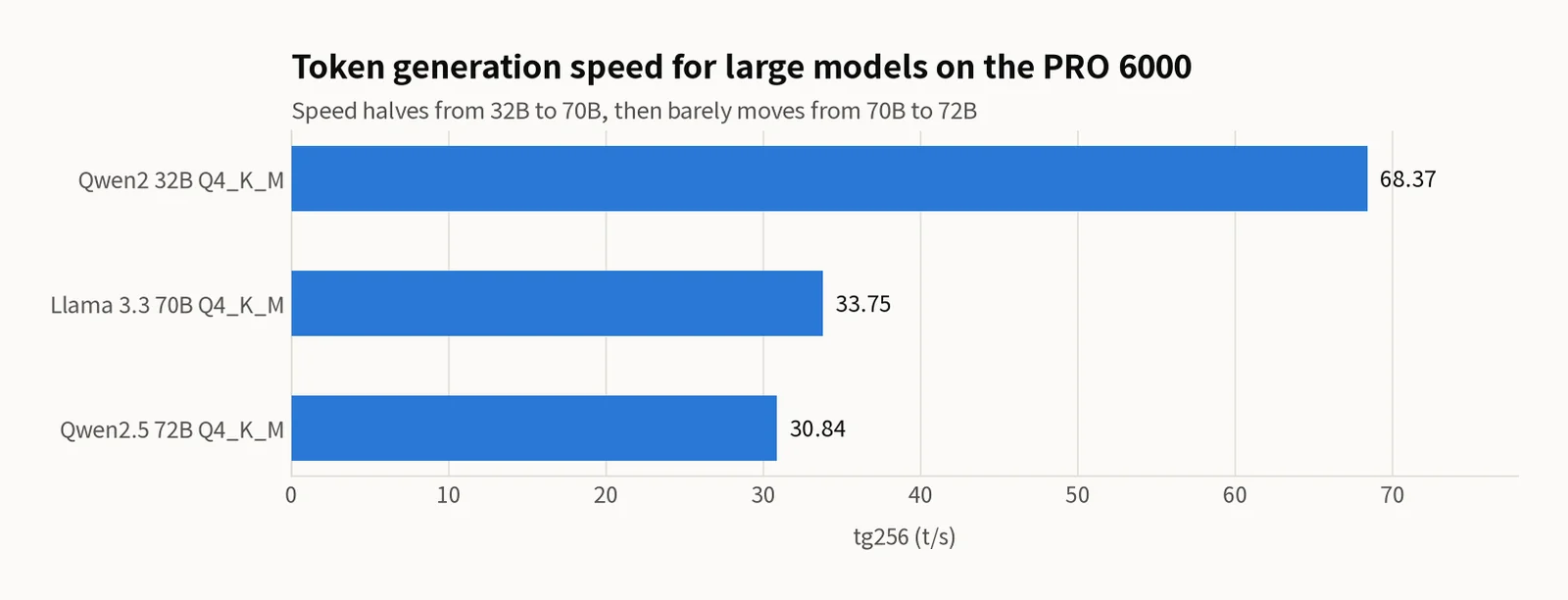
The PRO 6000 runs Llama 3.1 70B at 33.75 tok/s and Qwen2.5 72B at 30.84 tok/s — both above the comfortable reading threshold of 20 tok/s. This is the PRO 6000's primary value proposition: the ability to load and serve models that simply cannot run on consumer GPUs, no matter how fast their memory bandwidth is.
GPU Stress Test (gpu_burn)
We ran a 300-second gpu_burn stress test on the RTX 5090 to validate thermal stability and compute reliability under maximum sustained load.
| Metric | Result |
|---|---|
| Test Duration | 300 seconds |
| Peak Temperature | 72°C |
| Compute Errors | 0 |
| Sustained GFLOP/s | ~22,600 |
| Thermal Throttling | None observed |
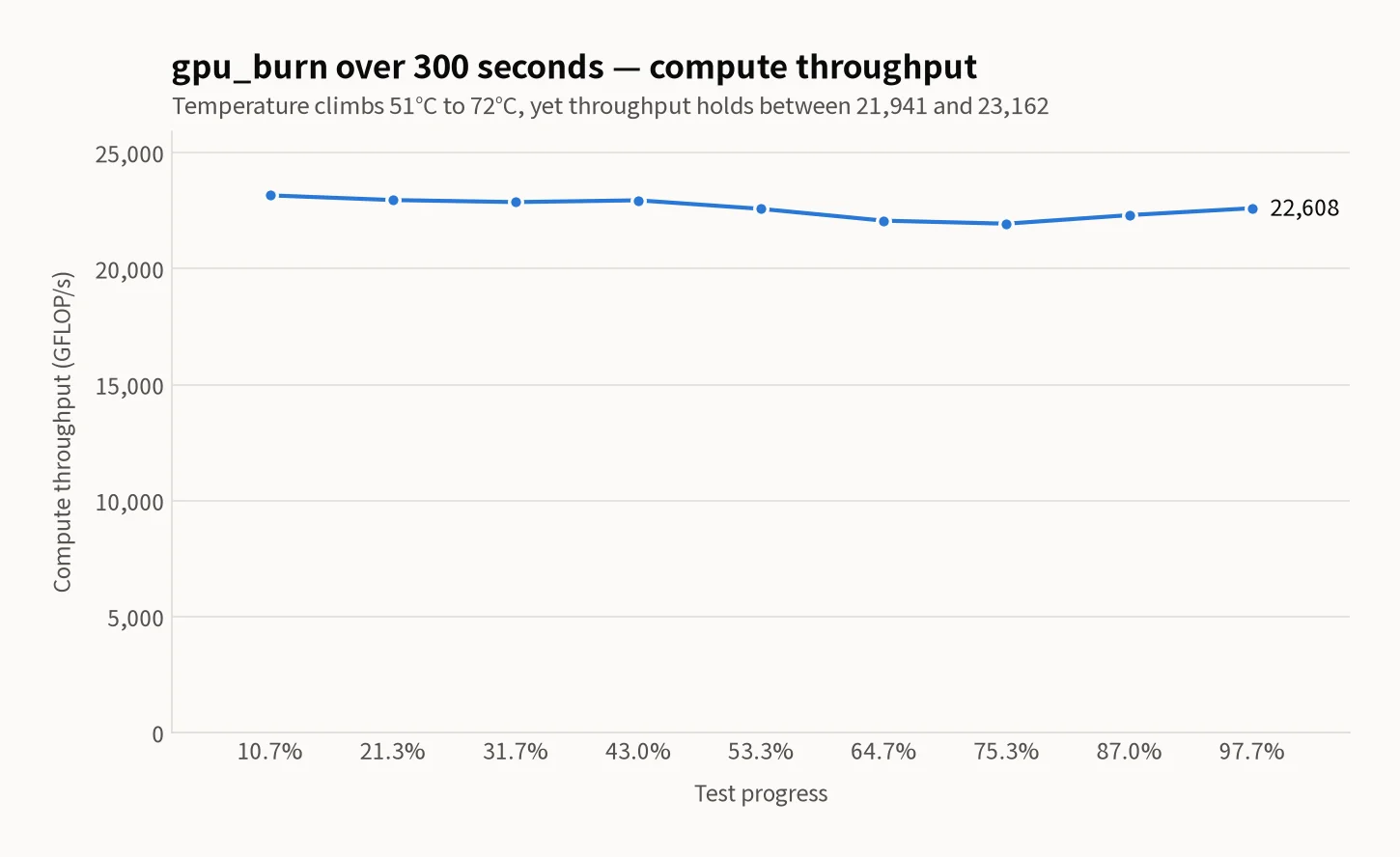
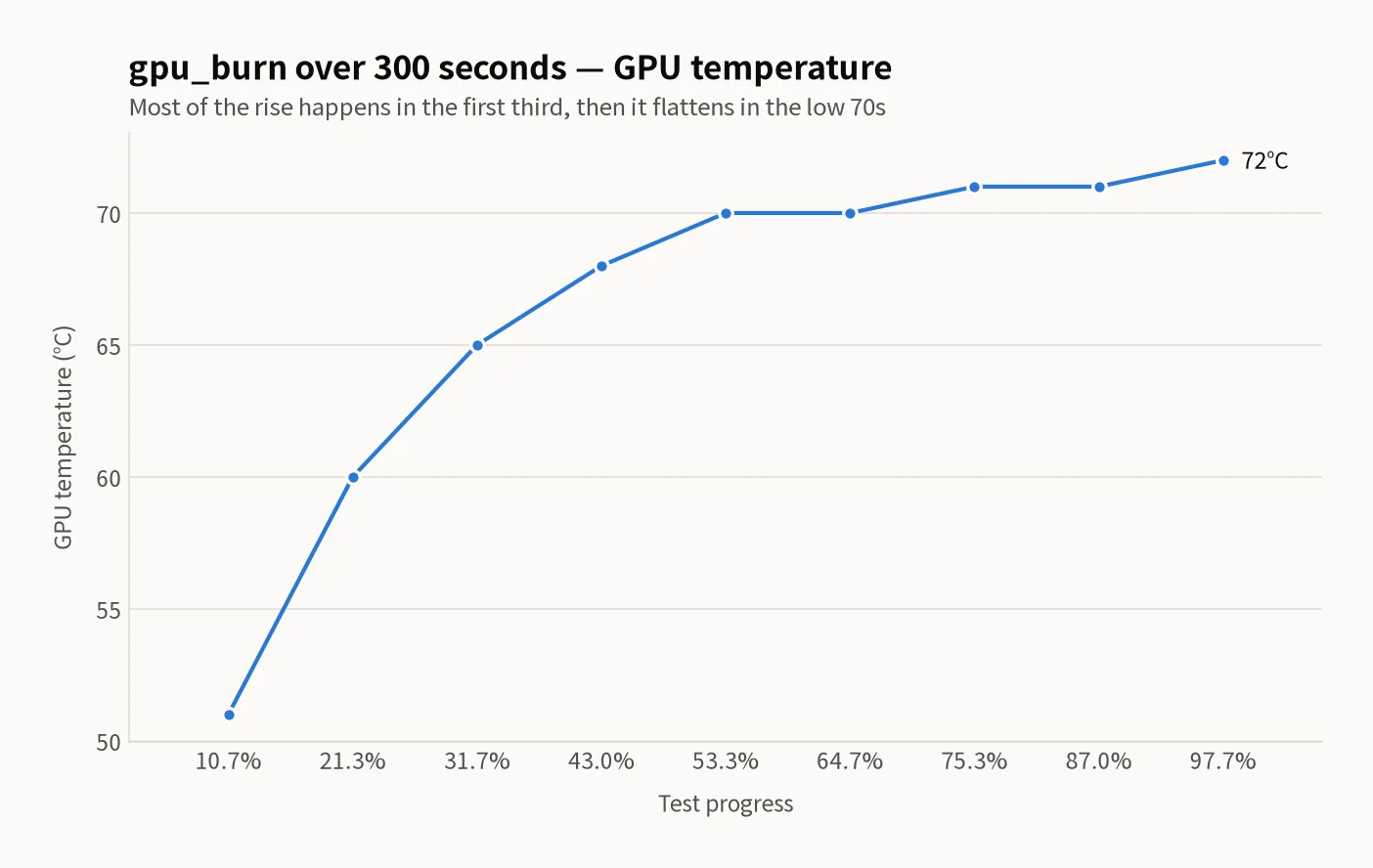
The RTX 5090 maintained 72°C with zero compute errors across 300 seconds of sustained maximum load. At ~22,600 GFLOP/s sustained throughput, the GPU demonstrated stable FP32 performance with no thermal throttling — confirming it can handle continuous AI inference workloads without reliability concerns.
Conclusion: When to Choose Each GPU
Choose the RTX 5090 ($1,999) if: Your largest model is 32B parameters or smaller. You get identical inference speed (~69 tok/s on 32B) at 40% of the cost. The higher memory bandwidth (1,792 GB/s) actually gives a slight edge in token generation. For startups or teams running 8B-32B models, this is the clear value winner.
Choose the RTX PRO 6000 ($5,000) if: You need to run 70B+ parameter models on a single GPU. No consumer card offers 96 GB VRAM. Running Llama 70B at 33 tok/s or Qwen 72B at 30 tok/s on one card, without multi-GPU complexity, is something only the PRO 6000 delivers.
The bottom line: The decision is entirely about model size, not speed. At 32B, both GPUs perform identically. The 2.5x price premium of the PRO 6000 buys you exactly one thing: 3x the VRAM to load larger models. If you do not need models above 32B, you are paying $3,000 extra for capacity you will never use.
Related Posts
© 2026 TreeRU. All rights reserved.
All content is copyrighted by TreeRU. Unauthorized reproduction without attribution is prohibited.