RTX 5060 Ti Local AI Benchmark - What Can a $450 GPU Actually Do?
Can a $450 consumer GPU run local AI models well enough for production use? We put the RTX 5060 Ti (16 GB GDDR7 VRAM) through a comprehensive benchmark: raw GPU performance with llama-bench, single-user inference speed with 8B and 14B models, concurrent load testing up to 30 users, multi-turn chat patterns, and cross-server inference overhead. Every result was measured, not estimated.
Test Environment
The RTX 5060 Ti is a Blackwell-architecture consumer GPU with 16 GB GDDR7 memory at 448 GB/s bandwidth and a 180W TDP. Our test server paired it with a 6-core CPU, 16 GB DDR5, and an NVMe SSD. Software stack: llama.cpp (build e877ad8, SM 12.0), SGLang 0.5.8.post1 with AWQ Marlin quantization, and PyTorch 2.9.1+cu128.
Models tested: Qwen3-8B-AWQ and Qwen3-14B-AWQ (both INT4 quantized), with 4,096-token context length. Raw performance was measured with Qwen2.5-7B-Instruct Q4_K_M via llama-bench.
Raw GPU Performance (llama-bench)
Before testing real serving scenarios, we measured pure compute throughput with llama-bench to establish the hardware baseline.
| GPU | pp512 (tok/s) | pp4096 (tok/s) | tg256 (tok/s) |
|---|---|---|---|
| RTX 5060 Ti | 3,740 | 2,791 | 84.5 |
| RTX PRO 6000 | 12,383 | 8,557 | 241.1 |
| 5060 Ti / PRO 6000 | 30% | 33% | 35% |
The RTX 5060 Ti delivers 35% of the PRO 6000's token generation speed — slightly above its memory bandwidth ratio (448 / 1,536 = 29%), indicating good cache efficiency. For a GPU costing 9% of the PRO 6000's price, 35% of the raw performance is an excellent value proposition.
8B Model Performance (Qwen3-8B-AWQ)
Single-User Speed
| Test | Response Time | Tokens | Speed |
|---|---|---|---|
| Short query (max=50) | 678 ms | 50 tok | 73.8 tok/s |
| Medium query (max=200) | 2,630 ms | 200 tok | 76.0 tok/s |
| Long response (max=500) | 6,552 ms | 500 tok | 76.3 tok/s |
Single-user speed holds remarkably consistent at 76 tok/s regardless of response length. VRAM usage sits at 80% (13.1 GB / 16.3 GB), and GPU temperature during inference is just 43°C.
Concurrent Load Test (Simple Requests, max_tokens=200)
| Concurrent Users | Total Requests | Median Latency | P95 | GPU Temp | Throughput |
|---|---|---|---|---|---|
| 1 | 5 | 2,635 ms | 3,010 ms | 42°C | 74 tok/s |
| 5 | 25 | 2,752 ms | 2,766 ms | 46°C | 363 tok/s |
| 10 | 50 | 2,924 ms | 2,954 ms | 49°C | 683 tok/s |
| 20 | 60 | 3,462 ms | 3,477 ms | 51°C | 1,154 tok/s |
| 30 | 60 | 3,577 ms | 3,598 ms | 53°C | 1,674 tok/s |
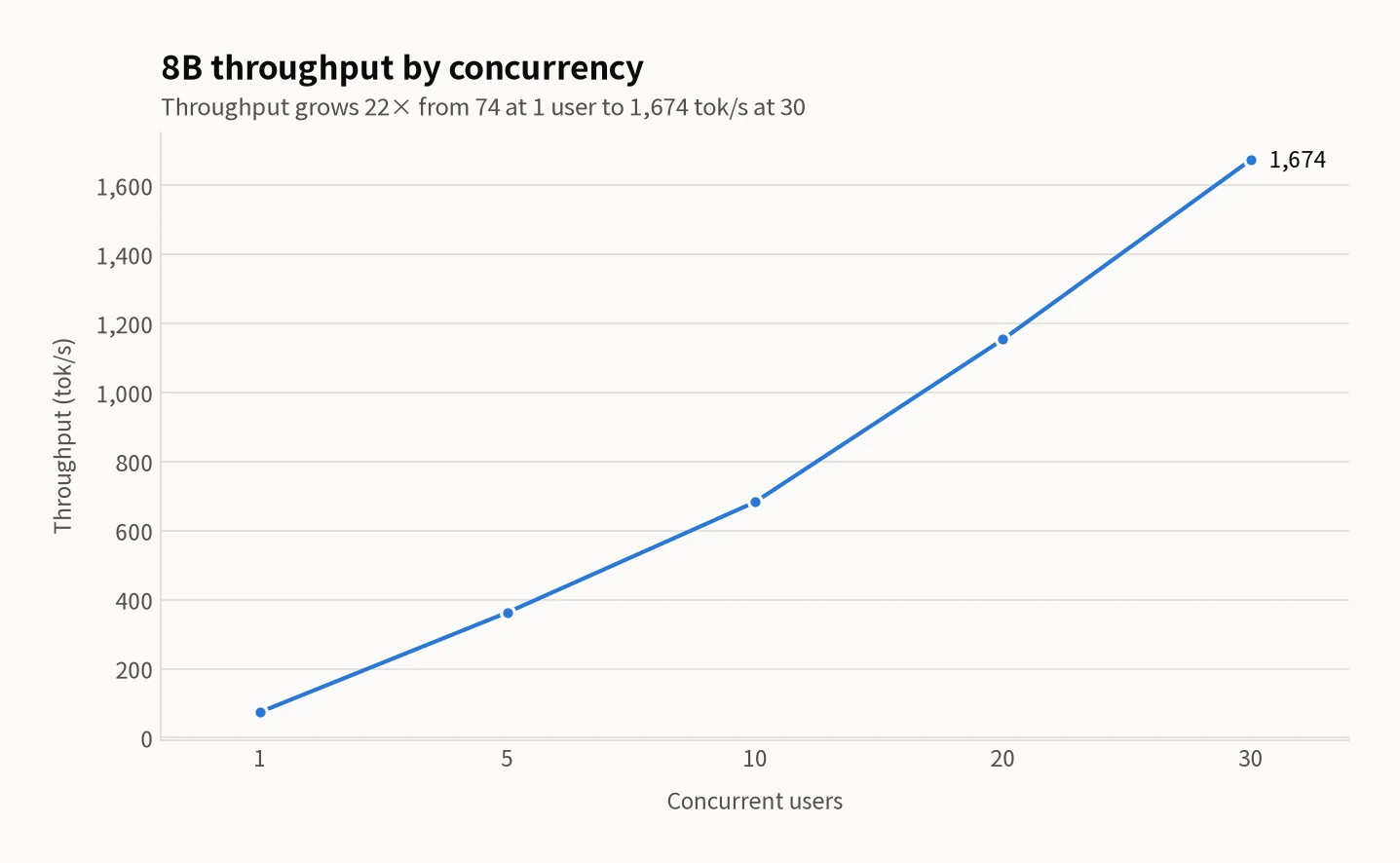
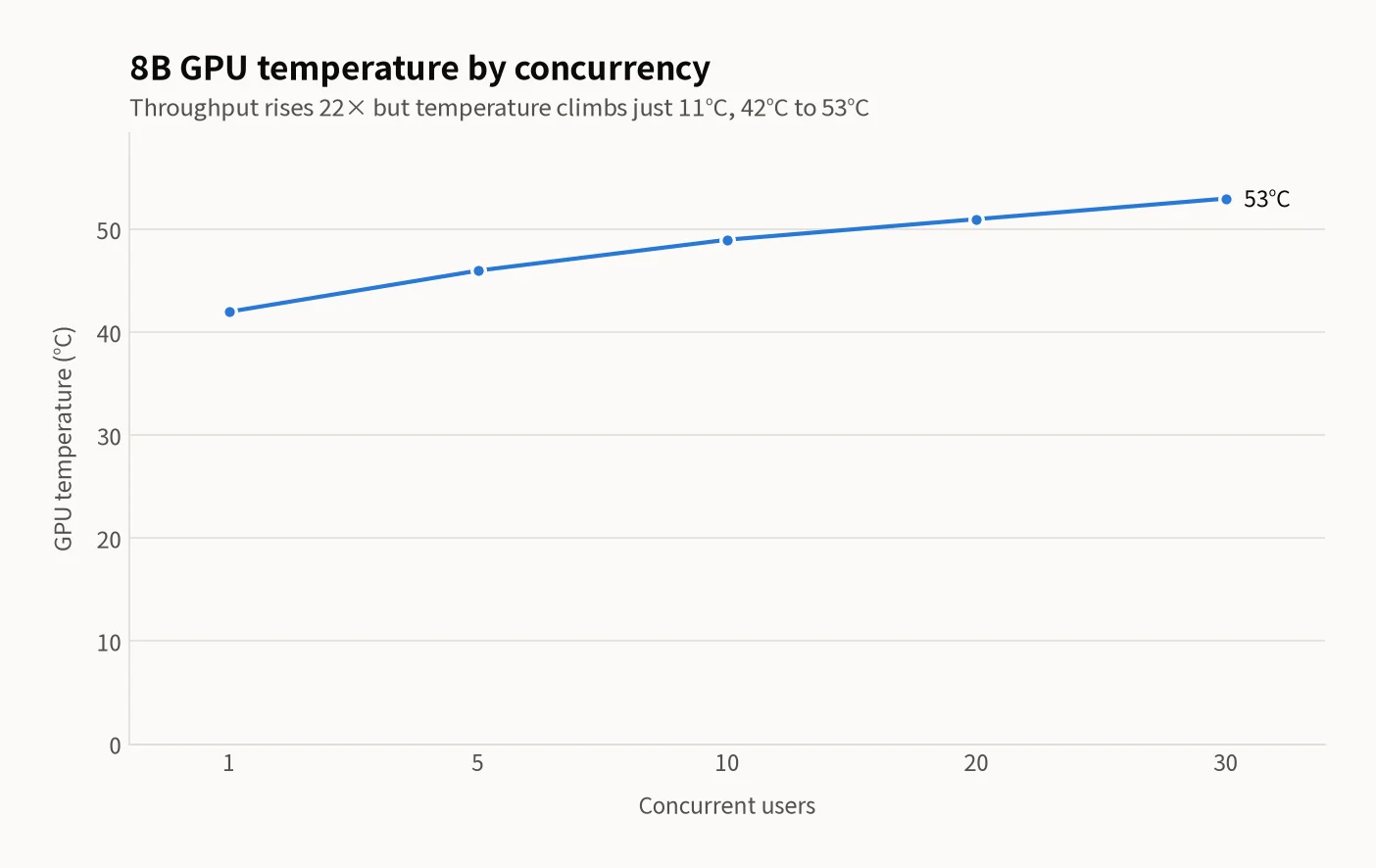
Zero errors across all concurrency levels up to 30 users. Throughput scales efficiently from 74 tok/s (single user) to 1,674 tok/s (30 users), demonstrating excellent continuous batching efficiency. Median latency increases from 2.6s to only 3.6s — a 36% increase for a 30x concurrency jump. GPU temperature peaks at just 53°C.
Multi-Turn Chat Pattern (max_tokens=500)
| Concurrent Users | Median Session Time | P95 | GPU Temp | Throughput |
|---|---|---|---|---|
| 1 | 26.8 s | 26.8 s | 40°C | 67 tok/s |
| 5 | 21.5 s | 28.6 s | 41°C | 257 tok/s |
| 10 | 23.0 s | 30.9 s | 41°C | 431 tok/s |
| 15 | 26.1 s | 33.9 s | 41°C | 671 tok/s |
| 20 | 28.9 s | 37.2 s | 42°C | 760 tok/s |
Even with 20 concurrent multi-turn chat sessions, the GPU stays at 42°C. Actual power draw is 35-120W against a 180W TDP, leaving significant thermal headroom for 24/7 operation.
14B Model Performance (Qwen3-14B-AWQ)
The 16 GB VRAM capacity allows running 14B models — a significant advantage over competing 12 GB cards that are limited to 8B models only. VRAM usage at 80% (13.1 GB) leaves comfortable headroom.
| Metric | Value |
|---|---|
| 60-Question Korean Test | Average 43 tok/s |
| Total Time | 1,069 s (17.8 min) |
| Total Tokens | 46,042 |
| Average Response Length | 767 tok |
| GPU Temperature | 51°C |
| Power Draw | ~123W |
At 43 tok/s, the 14B model generates text faster than most people read — making streaming output feel natural and responsive. With 5 concurrent users, multi-turn chat sessions complete in 11.2 seconds (median). Even at 20 concurrent users, the system remains stable at 55°C with zero errors.
8B vs 14B on RTX 5060 Ti
| Metric | 8B | 14B | Ratio |
|---|---|---|---|
| Single-User Speed | 76 tok/s | 43 tok/s | 57% |
| 20-User Median Latency | 3,462 ms | 4,117 ms | 1.2x slower |
| 20-User Throughput | 760 tok/s | 326 tok/s | 43% |
| Max Temperature (20 users) | 51°C | 55°C | +4°C |
Cross-Server Inference
We tested forwarding HTTP requests from the main server to the RTX 5060 Ti test server over a 1GbE network to measure cross-server inference overhead.
| Response Length | Direct | Cross-Server | Overhead |
|---|---|---|---|
| 50 tokens | 678 ms | 748 ms | +70 ms (+10%) |
| 200 tokens | 2,630 ms | 2,767 ms | +137 ms (+5%) |
| 500 tokens | 6,552 ms | 7,728 ms | +1,176 ms (+18%) |
For short to medium responses (50-200 tokens), network overhead is 5-10% — negligible for practical purposes. Longer responses (500+ tokens) incur 18% overhead on 1GbE, which would drop substantially with a 10GbE upgrade. This makes the RTX 5060 Ti viable as a satellite inference node, offloading lightweight requests from a more powerful main server.
Conclusion: Three Deployment Scenarios
Scenario 1 (Personal AI Server): At 76 tok/s with the 8B model, a single user gets real-time conversational AI with zero API costs. A $450 one-time investment replaces ongoing per-query charges indefinitely.
Scenario 2, Small Team Service (5-10 users): The 8B model handles 10 concurrent users comfortably; the 14B model handles 5 with higher response quality. With 180W TDP, 55°C peak temperature, and zero errors across all test configurations, 24/7 operation is completely viable.
Scenario 3 (Auxiliary GPU for Main Server): When a high-end GPU handles complex 32B+ model requests, the RTX 5060 Ti can offload FAQ responses, classification tasks, and lightweight queries. At 9% of the PRO 6000's price, it adds 35% of the raw performance — an excellent cost-efficiency strategy with minimal cross-server overhead on short requests.
| Specification | RTX 5060 Ti | RTX PRO 6000 |
|---|---|---|
| VRAM | 16 GB | 96 GB |
| Memory Bandwidth | 448 GB/s | 1,536 GB/s |
| 8B Single-User Speed | 76 tok/s | ~213 tok/s |
| 14B Single-User Speed | 43 tok/s | 135 tok/s |
| Max Servable Model | 14B AWQ | 70B+ |
| Comfortable Concurrency (8B) | 10 users | 50 users |
| Price | ~$450 | ~$5,000 |
| Performance per Dollar | High | Moderate |
The RTX 5060 Ti proves that local AI inference does not require enterprise-grade hardware. For $450, you get stable 8B model serving at 76 tok/s, zero-error operation up to 30 concurrent users, and the ability to run 14B models that 12 GB cards cannot touch. The thermal profile (55°C max, 120W actual draw) makes it suitable for always-on deployment without specialized cooling.
Related Posts
© 2026 TreeRU. All rights reserved.
All content is copyrighted by TreeRU. Unauthorized reproduction without attribution is prohibited.