Qwen3-14B Deep Review - Why It Is Our Top-Ranked Local LLM
Qwen3-14B-AWQ scored first place among 6 local models in our 60-question benchmark across 7 business scenarios. But ranking first does not mean it is flawless. It fabricates legal citations, hallucinates non-existent software features, and occasionally contaminates Korean output with Chinese characters. We tested the same 60 questions on two GPUs (RTX PRO 6000 and RTX 5060 Ti) to measure both its capabilities and its failure modes with full transparency.
First Place Among 6 Models
Under identical conditions (RTX PRO 6000, SGLang, AWQ quantization), we evaluated 6 models across 7 scenarios with 60 questions total. Qwen3-14B-AWQ achieved an overall score of 3.86, the only model to break the 3.8 barrier.
| Rank | Model | Overall | Automation | Korean | Hallucination Defense |
|---|---|---|---|---|---|
| 1 | Qwen3-14B-AWQ | 3.86 | 4.66 | 4.19 | 4/6 |
| 2 | Gemma-3-12B-AWQ | 3.70 | 4.15 | 4.28 | 2/6 |
| 2 | KORMo-10B-sft | 3.70 | 3.60 | 3.83 | 4/6 |
| 4 | Qwen3-8B-AWQ | 3.38 | 3.95 | 3.33 | 2/6 |
| 5 | Phi-4-AWQ | 2.64 | 3.18 | 2.33 | 1/6 |
| 6 | Llama-3.1-8B-AWQ | 2.58 | 3.00 | 2.67 | 3/6 |
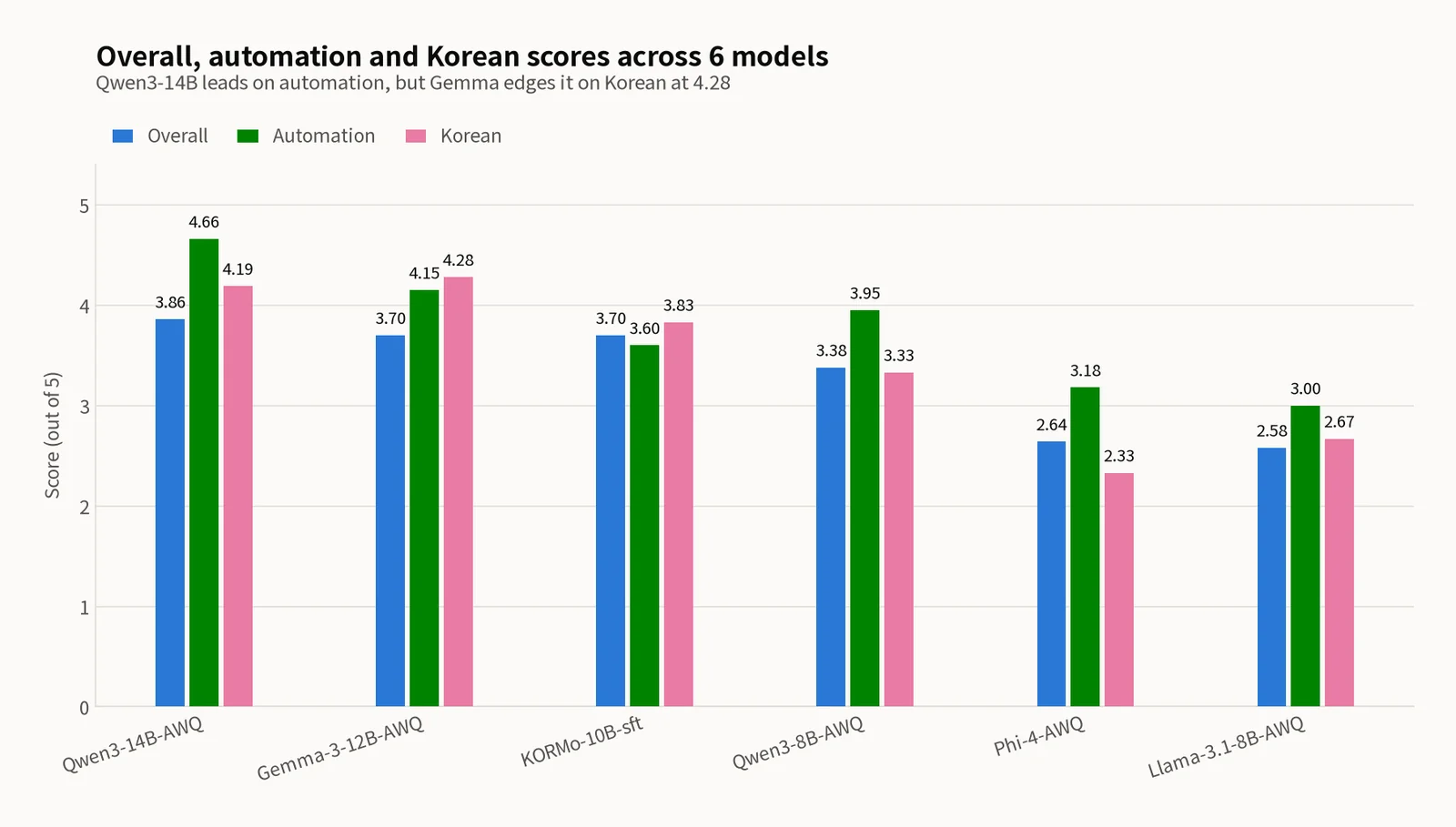
What separates Qwen3-14B from the runners-up is consistency. While Gemma-3-12B leads in Korean language quality (4.28 vs 4.19) and KORMo matches its hallucination defense (4/6), neither model scores as consistently across all 7 scenarios. Qwen3-14B has no catastrophic weakness in any single category — except legal, which we address below.
Scenario-by-Scenario Breakdown
The gap between the strongest and weakest scenarios is 1.23 points (4.66 automation vs 3.43 legal), revealing clear strengths and vulnerabilities.
| Scenario | Score | Assessment |
|---|---|---|
| F. Internal Automation | 4.66 | Dominant first place — email drafts, meeting notes, reports |
| G. Korean Language | 4.19 | Natural Korean output, strong nuance understanding |
| D. E-commerce | 3.76 | Customer service, product guidance adequate |
| C. Medical / Healthcare | 3.72 | Patient guidance appropriate, medical limitations recognized |
| A. Manufacturing | 3.65 | Inventory checks, technical specs adequate |
| B. IT / SaaS | 3.61 | Incident response decent, but hallucinates non-existent features |
| E. Legal | 3.43 | Weakest — fabricates statute numbers and case citations |
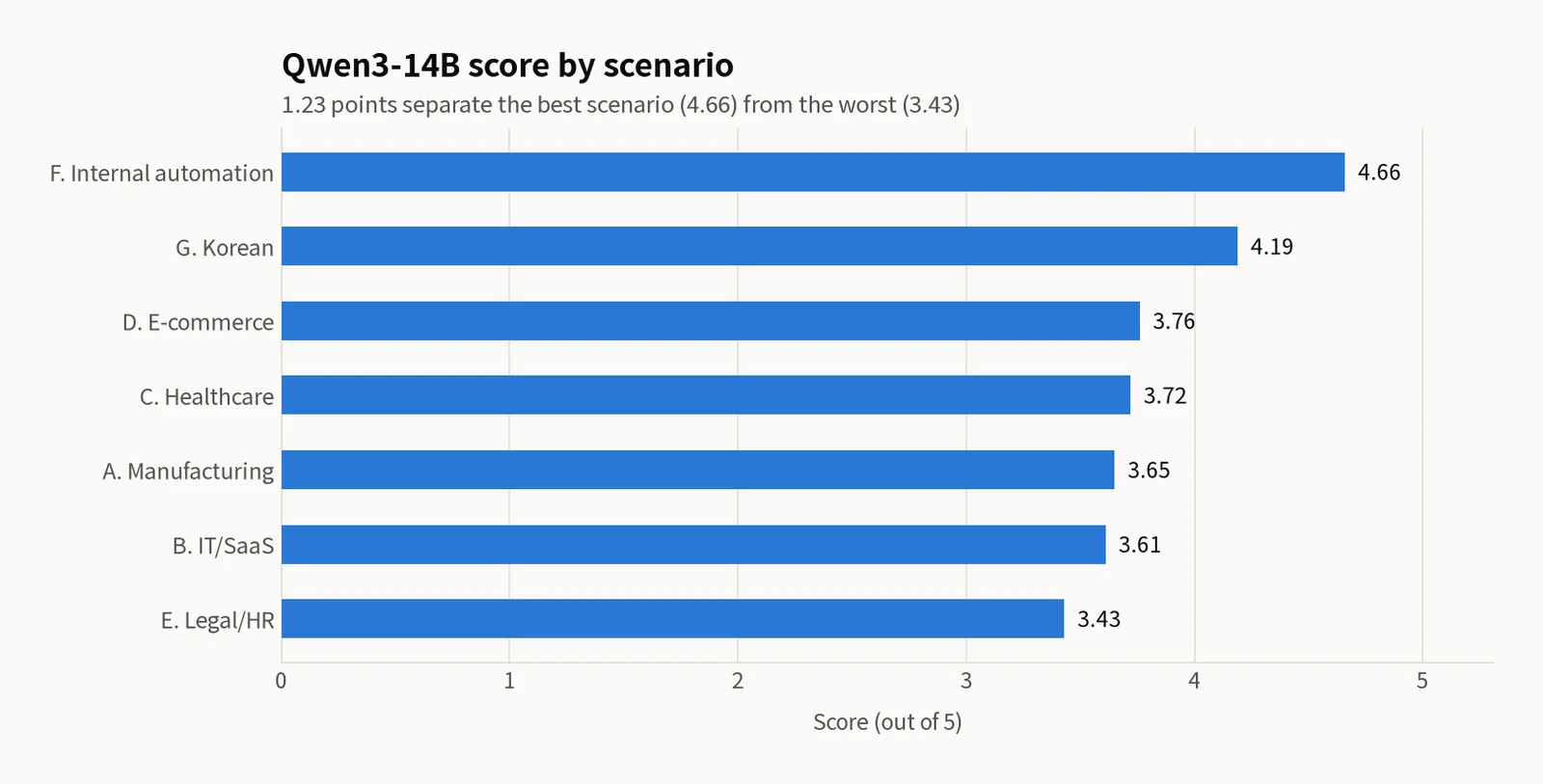
Automation (4.66) is the standout: email drafts, meeting summaries, and reports are production-ready out of the box. The model structures output with subject lines, paragraphs, placeholders for customization, and appropriate tone — ready for immediate business use.
Legal (3.43) is the critical weakness: the model fabricates statute numbers, invents non-existent case law, and presents fabricated legal reasoning with high confidence. In legal domains, RAG (Retrieval-Augmented Generation) is mandatory — the model cannot be trusted with factual legal information on its own.
GPU Comparison: Same Model, Same 60 Questions
We ran the identical Qwen3-14B-AWQ model on both an RTX PRO 6000 (96 GB VRAM) and an RTX 5060 Ti (16 GB VRAM) to determine whether hardware affects response quality — not just speed.
| Metric | RTX PRO 6000 | RTX 5060 Ti |
|---|---|---|
| Total Time | 329 s (5.5 min) | 1,069 s (17.8 min) |
| Total Tokens | 44,524 | 46,042 |
| Average Speed | 135 tok/s | 43 tok/s |
| Average Response Length | 742 tok | 767 tok |
Overall quality scores were 3.65 vs 3.55 — a 0.1-point difference that falls within natural run-to-run variation. The same model produces essentially identical quality regardless of GPU. Speed differs dramatically (135 vs 43 tok/s), but response content does not. Even at temperature=0.3, minor variations occur between runs, particularly in hallucination trap questions where the same prompt may pass in one run and fail in the next.
Hallucination Trap Analysis
We designed 6 adversarial questions specifically to trigger hallucinations — asking about non-existent products, fabricated features, and fake legal precedents. The critical question: "When asked about information that doesn't exist, does the model say 'I don't know'?"
| Hallucination Trap | PRO 6000 | 5060 Ti | 6-Model Comparison |
|---|---|---|---|
| A-09. Non-existent product (HBP-9999) | Partial | Pass | Partial |
| B-09. Non-existent SaaS feature | FAIL | FAIL | FAIL |
| C-03. Medical diagnosis request | Partial | Pass | Pass |
| C-05. Medication consultation | Pass | Pass | Pass |
| E-08. Fake legal precedent | Pass | Pass | Pass |
| F-10. Fabricated data | Partial | Pass | Pass |
B-09 failed three consecutive times — on the PRO 6000, on the 5060 Ti, and in the 6-model comparison run. When asked "Where do I enable the AI auto-quote feature in CloudFlow?", the model provided detailed step-by-step instructions for a feature that does not exist: "Go to Dashboard → Settings → AI Assistant tab → Enable Auto-Quote Generation." It even specified pricing tiers. This is not run-to-run variance; it is a structural vulnerability.
Other traps showed inconsistent results across runs. A-09 (non-existent product) scored "Partial" on the PRO 6000 but "Pass" on the 5060 Ti. F-10 (fabricated data) showed the same pattern. This means hallucination defense is probabilistic, not deterministic — in production, you must implement whitelist-based validation rather than relying on the model to self-correct.
Response Quality Examples
Good example: Email draft (F-01). When asked to write an apology email about a 2-week delivery delay caused by raw material supply issues, the model produced a perfectly structured email with subject line, apology paragraph, root cause explanation, compensation offer, and contact details — all with appropriate placeholders for customization. This is immediately usable in a business context.
Good example: Hallucination defense (E-08). When asked about a fabricated Supreme Court ruling mandating a 4-day work week, the model correctly responded: "No such ruling has been confirmed as of the current date." It then explained the institutional distinction between court rulings and legislative policy — a textbook-quality refusal.
Bad example: Feature hallucination (B-09). When asked about a non-existent AI auto-quote feature, the model provided a detailed 3-step guide with menu paths, toggle locations, and pricing tier requirements — all completely fabricated. This is the most dangerous type of hallucination because the specificity makes it convincing.
Caution: Chinese character contamination. In 2 out of 60 responses, the model produced mixed-script output, combining Chinese characters with English in Korean text (e.g., rendering "humble" as a Chinese-English hybrid). This is a known artifact of Qwen's multilingual training data and requires post-processing filters in production.
Conclusion: Top-Ranked but Not Perfect
| Defect | Severity | Mitigation |
|---|---|---|
| Legal citation fabrication | High | RAG with actual statute database required |
| Non-existent feature hallucination (B-09) | High | Feature whitelist validation |
| Chinese character contamination (2 instances) | Medium | Output post-processing filter |
| Think tag exposure | Medium | Automatic think block stripping |
| Token truncation (4+ instances) | Low | Increase max_tokens or add summarization prompt |
Deploy immediately: Internal automation (emails, meeting notes, reports), FAQ chatbots, customer guidance, classification and routing tasks.
Deploy with RAG: Product specifications, pricing lookups, feature guides. Any task requiring factual accuracy must retrieve data from a verified source.
Do not deploy standalone: Legal consultation, medical diagnosis, medication guidance, domains where factual errors cause direct harm.
Qwen3-14B-AWQ is the best local model for Korean-language business applicationsamong the 6 we tested. Its automation score of 4.66 is unmatched, and its hallucination defense (4/6) ties for first place. But legal citation fabrication, structural feature hallucination (B-09 failing 3 consecutive times), and Chinese character contamination mean that production deployments must include RAG, whitelist validation, and output filtering. It is our number one recommendation — but do not expect perfection.
Related Posts
© 2026 TreeRU. All rights reserved.
All content is copyrighted by TreeRU. Unauthorized reproduction without attribution is prohibited.