8B vs 14B vs 32B LLM: Concurrent User Benchmark on a Single GPU
The 8B model is fast but shallow. The 32B model is smart but slow. We benchmarked all three Qwen3 sizes on the same RTX PRO 6000 GPU, scaling from 1 to 200 concurrent users, to find the optimal balance between speed, throughput, GPU stability, and response quality.
3.0x
8B→32B Speed Gap
1,582
8B Throughput (tok/s)
3.86
14B Quality (#1)
0%
Error Rate (All Tests)
Test Configuration
All three models ran on an identical setup: NVIDIA RTX PRO 6000 (96GB GDDR7), SGLang serving engine, AWQ 4-bit quantization, 4,096-token context window. Each test simulated real chat patterns — 2–4 multi-turn conversations per user, max 500 output tokens, with 0.3–1 second reading pauses between turns. All measurements are non-streaming (full response completion before delivery).
Power limits were set to 350W for 8B and 14B, with 32B tested at both 600W (default) and 350W to evaluate the thermal trade-off.
Speed Comparison: A Consistent 3x Gap
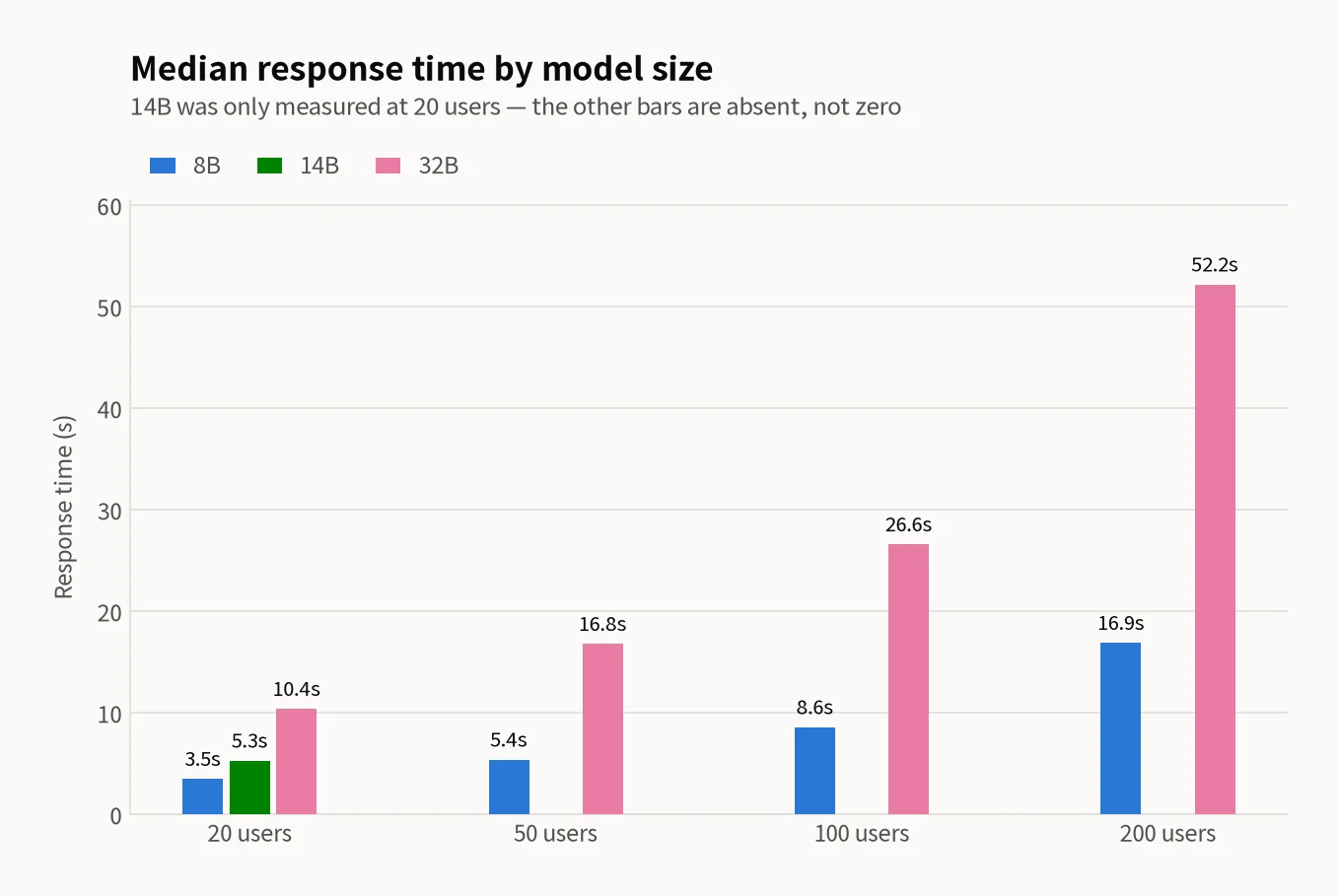
The core finding is remarkably consistent: going from 8B to 32B multiplies response latency by exactly 3x. This ratio holds whether you have 20, 50, 100, or 200 concurrent users.
| Metric (20 users) | 8B-AWQ | 14B-AWQ | 32B-AWQ |
|---|---|---|---|
| Median Latency | 3.5s | 5.3s | 10.4s |
| P95 Latency | 4.2s | 6.0s | 11.5s |
| Throughput | 1,582 tok/s | 1,049 tok/s | 650 tok/s |
| GPU Temperature | 43°C | 52°C | 61°C |
| vs 8B | — | 1.5x slower | 3.0x slower |
The scaling pattern is predictable: doubling model parameters increases latency by 1.5–2x. From 8B to 14B the multiplier is 1.5x; from 14B to 32B it jumps to 2.0x. This ratio stays remarkably stable across concurrent user counts, making capacity planning straightforward.
Throughput Scaling: More Users, Diminishing Returns
As concurrent users increase, batching efficiency improves and total throughput (tok/s) rises — but not linearly. A 10x increase in users yields only a 2.5x increase in throughput, because GPU compute is the fundamental bottleneck.
| Users | 8B Latency | 8B tok/s | 32B Latency | 32B tok/s |
|---|---|---|---|---|
| 20 | 3.5s | 1,582 | 10.4s | 650 |
| 50 | 5.4s | 2,590 | 16.8s | 1,122 |
| 100 | 8.6s | 3,469 | 26.6s | 1,385 |
| 200 | 16.9s | 3,890 | 52.2s | 1,429 |
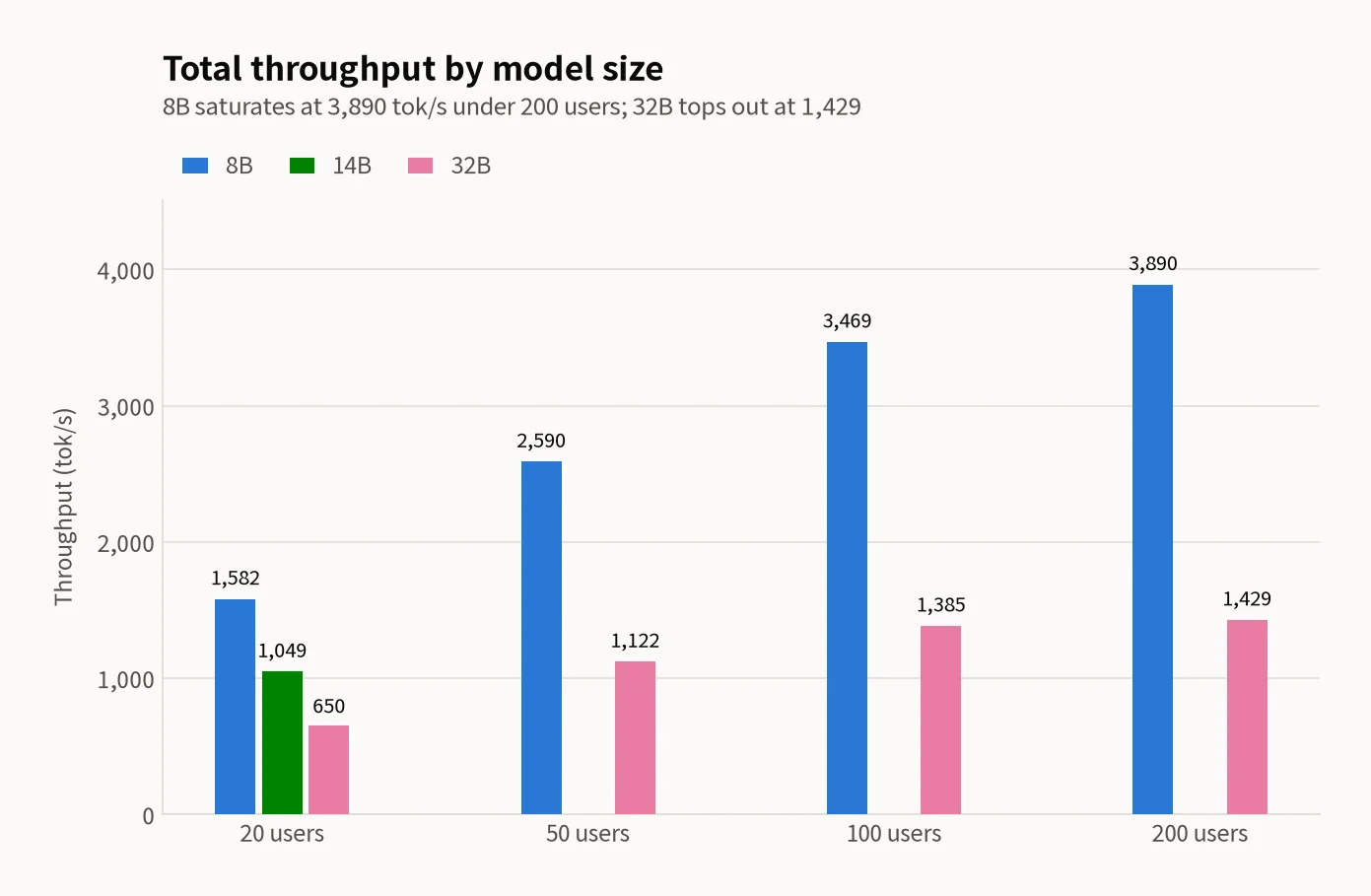
A striking comparison: the 32B model at 200 concurrent users (1,429 tok/s) still doesn't match the 8B model at just 20 users (1,582 tok/s). If raw throughput is your primary constraint, the 8B model dominates so thoroughly that no amount of batching can close the gap for larger models.
GPU Stability and Thermal Management
Larger models push the GPU harder. At 200 concurrent users, the 32B model hit 83°C and 606W — dangerously close to the thermal limit (85°C) and TDP ceiling (~600W). The 8B model at the same concurrency level sat at a comfortable 70°C and 532W.
Zero errors were recorded across all test configurations, which speaks to SGLang's stability. But thermal throttling at 83°C could cause performance degradation during sustained loads.
32B Power Limit: 600W vs 350W
We tested the 32B model with a 350W power limit to evaluate the temperature-performance trade-off:
| Users | 600W Latency | 350W Latency | Slowdown | 600W Temp | 350W Temp |
|---|---|---|---|---|---|
| 20 | 10.4s | 11.6s | +11% | 61°C | 47°C |
| 50 | 16.8s | 18.5s | +10% | 74°C | 56°C |
| 100 | 26.6s | 38.0s | +43% | 80°C | 60°C |
| 200 | 52.2s | 71.4s | +37% | 83°C | 61°C |
At low concurrency (20–50 users), the 350W limit adds only 10–11% latency while dropping temperature by 14–18°C. At high concurrency (100–200 users), the performance hit jumps to 37–43%, but temperature drops from 83°C to 61°C. The practical recommendation: run 350W for everyday operations and temporarily increase to 450–500W during peak events.
Quality vs Speed: The Core Trade-Off
Speed alone doesn't determine the right model. Using the same 60-question Korean business evaluation from our comprehensive benchmark, the 14B model scored 3.86/5 (1st place), while the 8B scored 3.38/5 — a gap of 0.48 points.
| Metric | 8B-AWQ | 14B-AWQ | 32B-AWQ |
|---|---|---|---|
| Overall Quality | 3.38 | 3.86 (#1) | Not tested* |
| Hallucination Defense | 2/6 | 4/6 | — |
| Automation Score | 3.95 | 4.66 | — |
| Korean Quality | 3.33 | 4.19 | — |
| Single-user Speed | 208 tok/s | 135 tok/s | 70 tok/s |
| 20-user Latency | 3.5s | 5.3s | 10.4s |
* 32B quality was not tested with the full 60-question evaluation. Larger models generally score higher, but the impact of AWQ quantization on 32B quality remains unverified.
The 14B model is the clear sweet spot: it scores 0.48 points higher than 8B while being only 1.5x slower. The 8B model is 1.5x faster but substantially weaker in hallucination defense (2/6 vs 4/6), Korean language quality (3.33 vs 4.19), and automation tasks (3.95 vs 4.66). Serving a fast but low-quality model at high speed is worse than serving a good model at moderate speed.
Secondary GPU: 14B on RTX 5060 Ti
For teams considering multi-GPU setups with consumer cards, we also tested the 14B model on an RTX 5060 Ti. The results show a 3.5x performance gap: 20 concurrent users took 18.8 seconds (vs 5.3s on PRO 6000), with throughput at 326 tok/s (vs 1,049 tok/s). The 5060 Ti is viable for up to 5 concurrent users but should be used as an overflow GPU rather than a primary server.
Recommendations by Scenario
- FAQ / classification / short responses: 8B. Speed is paramount, quality requirements are low. Handles 50 concurrent users comfortably at 5.4s median latency.
- Customer support / email drafting: 14B. The optimal balance point. With streaming (SSE), first tokens arrive in 1–2 seconds, making the 5.3s total latency feel responsive.
- Reports / complex document generation: 32B. Quality justifies the wait. Best with streaming enabled and concurrency limited to 20 users or fewer.
- High-traffic (50+ users): 8B exclusively, or implement model routing — 8B for simple queries, 14B for complex ones.
Conclusion: 14B Is the Sweet Spot
No single model size is optimal for every scenario. But if you can only deploy one model, 14B is the answer. It is 1.5x slower than 8B but scores 0.48 points higher in quality. It is 2x faster than 32B with half the GPU thermal load. With streaming enabled, 20 concurrent users experience responsive first-token delivery despite the 5.3-second total generation time.
The ideal production architecture uses model routing: 8B handles high-volume simple queries (FAQ, classification), 14B handles the core workload (support, content generation), and 32B is reserved for complex tasks routed on demand. This tiered approach maximizes throughput where speed matters and quality where accuracy matters, all on a single GPU.
Related Posts
© 2026 TreeRU. All rights reserved.
All content is copyrighted by TreeRU. Unauthorized reproduction without attribution is prohibited.