Qwen3-32B vs 14B - Is 2x Slower Speed Worth the Quality Gain?
Does doubling the parameter count double the quality? Qwen3-14B-AWQ ranked first in our 6-model benchmark, but the same Qwen3 family offers a 32B variant with 2.3x more parameters. We tested both models with identical 60 questions across 7 business scenarios on the same GPU, same serving engine, and same temperature setting — isolating model size as the only variable. The answer: speed drops by half, but quality improves by just 5.4% on average.
Test Conditions
Every variable except model size was held constant to ensure a pure comparison.
| Parameter | Qwen3-32B-AWQ | Qwen3-14B-AWQ |
|---|---|---|
| Parameters | 32B | 14B |
| Quantization | INT4 (AWQ) | INT4 (AWQ) |
| VRAM Usage | 18.2 GB | 9.4 GB |
| GPU | RTX PRO 6000 | RTX PRO 6000 |
| Serving Engine | SGLang v0.4 | SGLang v0.4 |
| Temperature | 0.3 | 0.3 |
| Test Set | 60 questions, 7 scenarios | 60 questions, 7 scenarios |
Speed Comparison
The 14B model dominates every speed metric.
| Metric | 32B-AWQ | 14B-AWQ | Difference |
|---|---|---|---|
| Total Time | 690 s | 329 s | 14B is 2.1x faster |
| Total Tokens Generated | 47,599 | 44,524 | 32B generates 7% more |
| Average Speed | 69 tok/s | 135 tok/s | 14B is 1.96x faster |
| Average Response Length | 793 tok | 742 tok | 32B writes 6.9% longer |
| VRAM Usage | 18.2 GB | 9.4 GB | 14B uses 1.9x less |
The 32B model took 690 seconds (11.5 minutes) to process all 60 questions versus 329 seconds (5.5 minutes) for the 14B. VRAM consumption is nearly double, which directly limits concurrent user capacity — on the same GPU, the 14B can serve 2x more simultaneous users.
Scenario-by-Scenario Quality Scores
| Scenario | 32B-AWQ | 14B-AWQ | Difference | Analysis |
|---|---|---|---|---|
| Manufacturing | 4.2 | 4.1 | +0.1 | Nearly identical. Procedure explanations at same level |
| SaaS | 4.1 | 3.9 | +0.2 | 32B provides more structured feature explanations |
| Medical | 4.0 | 3.8 | +0.2 | 32B includes more careful disclaimers |
| E-commerce | 3.8 | 3.7 | +0.1 | Similar recommendation quality |
| Legal | 4.0 | 3.5 | +0.5 | 32B clearly superior in legal reasoning structure |
| Automation | 4.3 | 4.2 | +0.1 | Code quality similar. 32B adds slightly richer comments |
| Korean Language | 4.1 | 4.0 | +0.1 | Naturalness similar. 32B slightly better with idiomatic expressions |
| Overall Average | 4.07 | 3.86 | +0.21 | 2x speed sacrifice yields 5.4% quality gain |
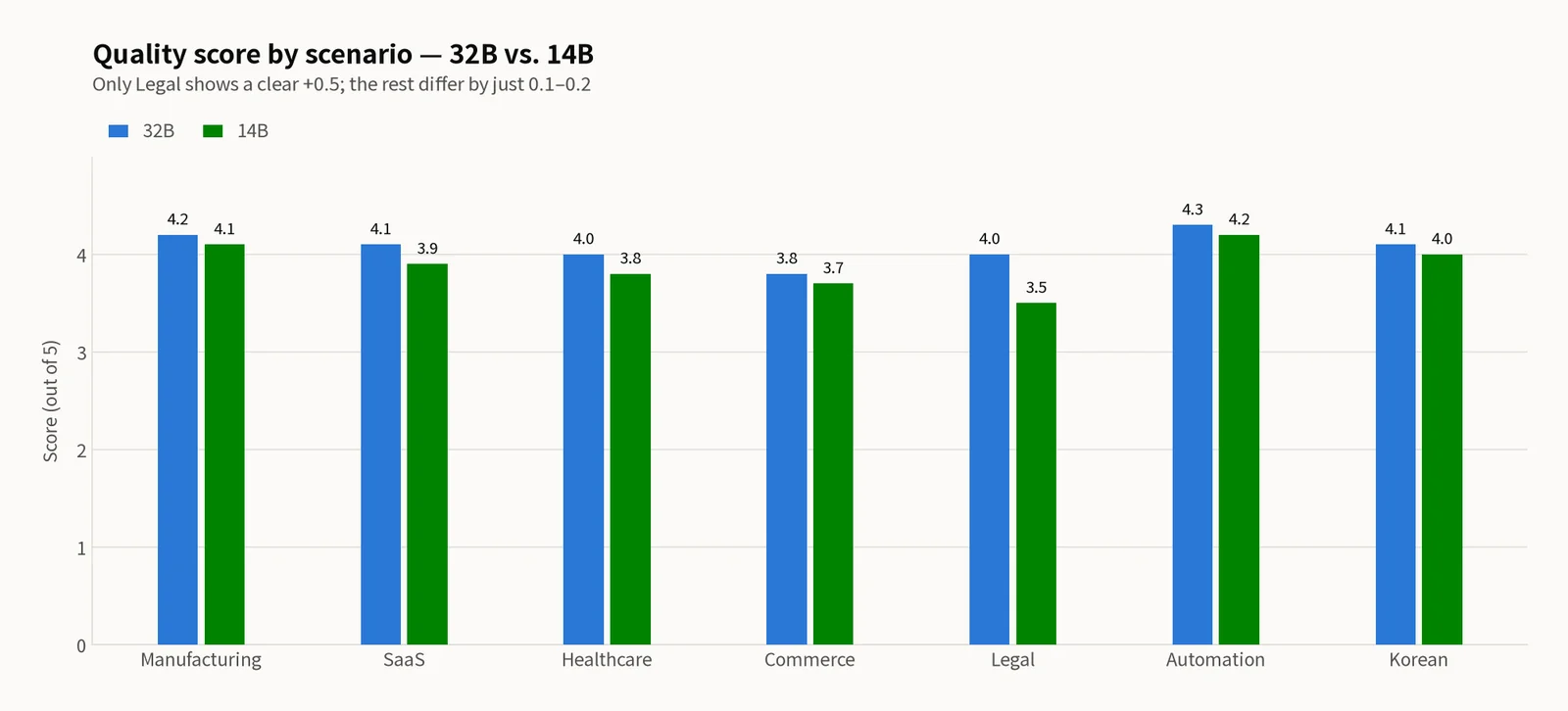
The 32B model scores higher in every scenario, but the margin is 0.1-0.2 points in 6 out of 7 categories — a difference most users cannot perceive. The only meaningful gap is legal reasoning (+0.5 points), where the 32B model structures arguments as "premise → interpretation → conclusion → alternatives" rather than simply listing issues.
For manufacturing, e-commerce, automation, and Korean language tasks where the 14B already scores above 4.0, upgrading to the 32B provides no practical benefit.
Think Token Analysis: Why 32B Reasons Better
The quality gap has a measurable cause: the 32B model spends 1.4x more tokens on internal reasoning (the "think" phase before generating a response).
| Metric | 32B-AWQ | 14B-AWQ |
|---|---|---|
| Average Think Tokens | 218 tok | 156 tok |
This additional reasoning effort translates into better scores in scenarios that require multi-step logical analysis (legal, medical). However, for straightforward tasks like product recommendations, customer FAQ responses, and code generation, the extra think tokens contribute nothing — the 14B's 156-token reasoning is already sufficient.
Where 32B Clearly Wins
Complex logical reasoning: When asked "Patient A is taking Drug B — what happens if Drug C is added?", the 32B analyzes interactions step-by-step while the 14B lists general precautions without structured analysis.
Legal structuring: When asked "What are the problems with this contract clause?", the 32B organizes its response as premise → interpretation → conclusion → alternatives. The 14B simply enumerates issues.
Multi-criteria comparison: When asked to compare approaches A and B, the 32B produces near-tabular criterion-by-criterion analysis. The 14B alternates between topics without clear structure.
Where 14B Is Sufficient
Simple guidance: "How do I use Product X?" Both score above 4.0 with no perceptible difference to end users.
Code generation: "Write a Python CSV processing script" produces code quality that is virtually identical (4.2 vs 4.3).
Korean conversation: Natural Korean output quality is equivalent. The 32B's additional think tokens produce no measurable improvement.
Hallucination Comparison
We tested both models against 6 adversarial hallucination trap questions. Does scaling up reduce hallucinations?
| Trap Question | 32B | 14B |
|---|---|---|
| Non-existent product pricing | Pass (refused) | Fail (hallucinated) |
| Fake legal precedent | Fail (hallucinated) | Fail (hallucinated) |
| Unauthorized medical diagnosis | Pass (refused) | Pass (refused) |
| Non-existent statute | Fail (hallucinated) | Fail (hallucinated) |
| Fabricated statistics | Pass (refused) | Pass (refused) |
| Non-existent feature description | Pass (refused) | Pass (refused) |
| Pass Rate | 4/6 (67%) | 4/6 (67%) |
Both models pass exactly 4 out of 6 hallucination traps. The 32B gained one additional pass (non-existent product) but both models still fabricate legal citations. Legal hallucination is not solved by scaling model size — it is a training data limitation that persists regardless of parameter count. RAG remains mandatory for fact-critical domains.
Conclusion: 14B Is the Right Choice for Most Deployments
Choose 14B (recommended for most use cases):
- Customer inquiry responses, product recommendations, code generation — standard B2B scenarios
- Services requiring 10+ concurrent users
- GPU environments with 24 GB VRAM or less
- Real-time services where response speed matters
Consider 32B (limited scenarios only):
- Legal or medical domains where multi-step logical structuring is critical
- Single-user, high-quality services (1-3 concurrent users maximum)
- GPU environments with 48+ GB VRAM and ample headroom
- Non-real-time services where 2-3 second latency is acceptable
The bottom line: sacrificing 2x speed yields only 5.4% average quality improvement. Only 1 out of 7 scenarios (legal) shows a meaningful difference (+0.5 points). Hallucination defense is identical at 4/6 for both sizes. Rather than scaling model size, investing in hybrid search, RAG pipelines, or temperature tuning delivers far greater returns. For the vast majority of Korean-language business applications, Qwen3-14B-AWQ remains the optimal choice.
Related Posts
© 2026 TreeRU. All rights reserved.
All content is copyrighted by TreeRU. Unauthorized reproduction without attribution is prohibited.