8 Time-Series Database Engines Compared - 22 Million Row Benchmark
When you need to store and analyze tens of millions of time-series records, which database should you choose? IoT sensor logs, server metrics, real-time traffic data, financial tick data. Large-scale time-indexed datasets hit the limits of general-purpose RDBMS fast. We benchmarked 8 database engines against 22 million time-series rows under identical conditions. Aggregate query speeds ranged from 25ms to 3,493ms — a 140x difference.
Why Dedicated Time-Series Databases?
Time-series data has fundamentally different characteristics from general relational data. Writes are almost exclusively append-only in chronological order. Reads are dominated by time-range aggregate queries. Updates are rare. A standard PostgreSQL query that takes 3,493ms drops to 25ms on a purpose-built engine. The difference comes from storage layout, indexing strategy, and query optimization designed for temporal data.
Time-Series Data Characteristics
- Write pattern: 99%+ append-only, ordered by timestamp
- Read pattern: Time-range aggregation (5-min, 1-hour, 1-day buckets)
- Volume: Tens of thousands to millions of rows per second
- Retention: Old data gets downsampled or deleted
- Compression: Time-sorted data achieves 90%+ compression
General RDBMS Limitations
- Row-based storage scans unnecessary columns during aggregation
- B-tree indexes are inefficient for time-range scans
- VACUUM overhead degrades performance after mass INSERTs
- No native compression — storage costs grow linearly
- Time-based partitioning requires manual management
Common Use Cases
| Domain | Example Data |
|---|---|
| Server monitoring | CPU, memory, disk metrics |
| IoT / sensors | Temperature, humidity, vibration readings |
| Traffic analysis | Request count, response time, error rate |
| Financial data | Price movements, trading volume |
Test Environment and Evaluation Criteria
We tested with 22 million time-series rows (timestamp + 4 numeric columns + volume), measuring time-range aggregate query response times. Beyond raw performance, we scored each engine across 6 practical criteria on a 100-point scale.
Dataset Specifications
- Row count: 22 million
- Columns: timestamp, open, high, low, close, volume
- Time span: ~20 years of mixed minute/daily bars
- Raw size: ~4.2GB (CSV)
Benchmark Query
- Time-range aggregation (5-min / 1-hour / 1-day buckets)
- FIRST/LAST value extraction
- MAX/MIN/SUM calculations
- Multi-symbol filter + aggregation
Six Evaluation Criteria
- SQL compatibility: Standard SQL support level
- AI/ML integration: Python, vector, and pipeline compatibility
- Frontend speed: Dashboard response time
- Ecosystem: Tools, drivers, community size
- Ease of learning: Adoption and operational difficulty
- Scalability: Horizontal scaling, clustering support
Overall Rankings
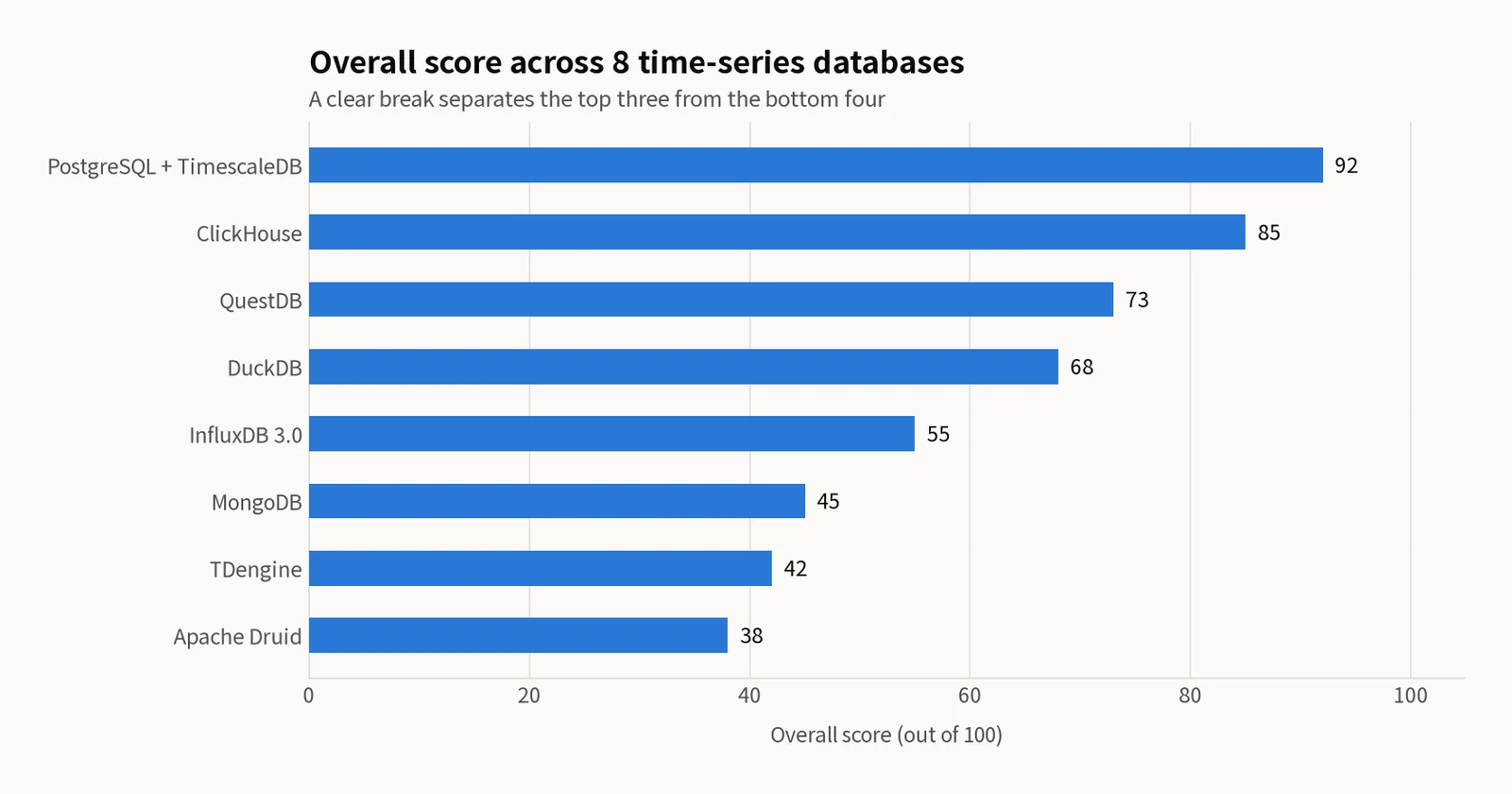
Combining aggregate query performance, ingestion throughput, compression ratio, and the 6 practical evaluation criteria, here are the final rankings on a 100-point scale.
| # | Engine | Type | Query Speed | Ingestion | Compression | Score |
|---|---|---|---|---|---|---|
| 1 | PostgreSQL + TimescaleDB | Time-series RDBMS | 1,021ms | 220K rows/s | 90%+ | 92/100 |
| 2 | ClickHouse | Columnar OLAP | 547ms | 1M+ rows/s | 95%+ | 85/100 |
| 3 | QuestDB | Time-series DB | 25ms | 4M+ rows/s | 85%+ | 73/100 |
| 4 | DuckDB | Embedded OLAP | ~500ms | Local optimized | Parquet | 68/100 |
| 5 | InfluxDB 3.0 | Time-series DB | N/A | High | Arrow+Parquet | 55/100 |
| 6 | MongoDB | Document NoSQL | High | Medium | WiredTiger | 45/100 |
| 7 | TDengine | IoT Time-series | ~300ms | High | 90%+ | 42/100 |
| 8 | Apache Druid | Real-time OLAP | Fast | High | Columnar | 38/100 |
Why the Top 3 Stand Out
- TimescaleDB (92 points): The best balance of PostgreSQL compatibility and time-series optimization. Existing PostgreSQL infrastructure can be reused directly.
- ClickHouse (85 points): Fastest pure analytical query speed. Ingests 1M+ rows/s with 95%+ compression. Ideal for analytics-heavy workloads.
- QuestDB (73 points): 25ms aggregate queries are unmatched, but limited ecosystem and missing OLTP features lower its overall score.
Why Lower-Ranked Engines Score Low
- MongoDB (45): Not purpose-built for time-series. Document model creates structural limitations for aggregation.
- TDengine (42): IoT-specialized with limited general-purpose use. Small community.
- Apache Druid (38): Extremely high operational complexity. Unrealistic for small teams.
Aggregate Query Benchmark
Time-range aggregate queries (OHLCV aggregation per time bucket) were run against all 22 million rows. Each query was written in the engine's native syntax for fair comparison.
| Engine | Query Time | vs PostgreSQL |
|---|---|---|
| QuestDB | 25ms | 140x faster |
| KDB+ | 109ms (commercial) | 32x faster |
| TDengine | ~300ms | 12x faster |
| DuckDB | ~500ms | 7x faster |
| ClickHouse | 547ms | 6x faster |
| TimescaleDB | 1,021ms | 3.4x faster |
| PostgreSQL | 3,493ms | baseline |
Why Such a Massive Speed Difference?
PostgreSQL (3,493ms) uses row-based storage that scans all columns during aggregation, lacks native time-bucket functions, and suffers from excessive I/O without compression or partitioning.
QuestDB (25ms) uses columnar storage with native time partitioning, aSAMPLE BY syntax optimized for time aggregation, and memory-mapped I/O that minimizes disk access.
Why Query Speed Alone Is Not Enough
QuestDB is the fastest at 25ms, yet it ranks 3rd overall. It lacks UPDATE/DELETE support, has limited JOIN capabilities, and a smaller ecosystem — all significant constraints in production. TimescaleDB at 1,021ms is 40x slower, but gives you full PostgreSQL functionality. Its Continuous Aggregates feature caches results in real-time, bringing actual dashboard response times down to single-digit milliseconds.
Deep Comparison by Engine
PostgreSQL + TimescaleDB (Rank 1, Score 92/100)
TimescaleDB extends PostgreSQL with time-series optimizations while preserving 100% SQL compatibility. Key features include time_bucket(), FIRST(),LAST() functions, Continuous Aggregates for automated real-time caching, and 90%+ native compression. The pgvector extension adds AI vector search capability.
Strengths: Minimal migration from existing PostgreSQL, all PostgreSQL tools and drivers work out of the box, Continuous Aggregates automate materialized views. Weaknesses: Pure analytical query speed trails columnar databases, multi-node horizontal scaling has been discontinued.
ClickHouse (Rank 2, Score 85/100)
ClickHouse is a columnar OLAP database optimized for analytical queries. It achieves 547ms aggregate queries, ingests over 1 million rows per second, and compresses data by 95%+. Materialized Views provide automatic aggregation, and native horizontal scaling is built in.
Strengths: Best-in-class analytical speed, massive ingestion throughput, fully open source (Apache 2.0). Weaknesses: Limited UPDATE/DELETE (not suitable for OLTP), requires separate operation from PostgreSQL, steeper learning curve, no transaction support.
QuestDB (Rank 3, Score 73/100)
QuestDB is a purpose-built time-series database with the fastest aggregate query speed in this benchmark at 25ms. It natively supports ASOF JOIN (critical for time-series data alignment), SAMPLE BY for time aggregation, and LATEST ON for retrieving the most recent values. Ingestion peaks at 4M+ rows/s.
Strengths: Unmatched time-series query speed, PostgreSQL wire protocol compatibility, completely free (Apache 2.0). Weaknesses: No UPDATE/DELETE, limited JOIN support, small ecosystem, requires a separate DB for metadata management.
DuckDB (Rank 4, Score 68/100)
DuckDB is an embedded OLAP engine — install with pip install duckdb and query Parquet/CSV files directly. Native Python/Pandas integration makes it ideal for ML pipelines and feature engineering. It supports ASOF JOIN and runs entirely in-process.
Strengths: Zero-install, queries files directly, deep Python integration. Weaknesses: Single-process (no concurrent connections), not designed for production serving, unsuitable for real-time ingestion.
InfluxDB 3.0 (Rank 5, Score 55/100)
InfluxDB 3.0 is a complete rewrite in Rust with an Arrow + Parquet architecture. It switches from Flux to SQL as the primary query language and removes cardinality limits. However, the Core edition has a 72-hour retention limit, Continuous Aggregates are not supported, and it is incompatible with previous InfluxDB versions.
Remaining Engines (Ranks 6–8)
| Engine | Position | Best For | Limitation |
|---|---|---|---|
| MongoDB | Document NoSQL | Schema-flexible log storage | Slow aggregation, not optimized for time-series |
| TDengine | IoT time-series | Mass IoT device ingestion | Small community, low SQL compatibility |
| Apache Druid | Real-time OLAP | Large-scale real-time dashboards | Extreme operational complexity |
Recommended Architecture
Trying to solve everything with a single database fails. The key is placing the right tool at each layer: ingestion, storage, analysis, and serving.
| Layer | Recommended Tools | Purpose |
|---|---|---|
| Data ingestion | Python, Celery + Redis, APScheduler | Periodic collection from multiple sources |
| Main storage | PostgreSQL + TimescaleDB | Unified time-series, metadata, and user data |
| Caching | Redis (open source) | Recent data cache, API response cache, Pub/Sub |
| Analytics | DuckDB / ClickHouse | Batch analysis, statistics, ML feature generation |
| AI/ML | Python + PyTorch, DuckDB, Parquet | Model training, embedding, inference pipeline |
| API | FastAPI / Next.js API | Serve data to frontend and AI modules |
| Frontend | Next.js + React, charting libraries | Real-time charts, dashboards, visualization |
Why Multi-Database?
No single engine covers all needs. TimescaleDB is slow for heavy analytics, so pair it with ClickHouse or DuckDB. ClickHouse cannot handle OLTP, so you still need PostgreSQL for metadata. QuestDB has limited JOINs — complex queries require a different engine.
Recommended combinations by scale:
- Small: TimescaleDB alone (sufficient for most use cases)
- Medium: TimescaleDB + DuckDB (analytics supplement)
- Large: TimescaleDB + ClickHouse + Redis (full pipeline)
Use-Case Selection Guide
General-Purpose Time-Series Storage
When you need CRUD + time-series aggregation in a single database with existing PostgreSQL infrastructure: choose TimescaleDB (score 92/100). Full SQL compatibility, pgvector for AI extension.
Large-Scale Analytics / Dashboards
When serving real-time aggregate dashboards over hundreds of millions of rows: choose ClickHouse (547ms aggregation, 1M+ rows/s ingestion, 95% compression).
Ultra-Low-Latency Time-Series Queries
When millisecond response times are required for real-time monitoring or trading systems: choose QuestDB (25ms aggregation, native ASOF JOIN, read-only analytics layer).
ML/AI Pipeline
For data exploration, feature engineering, and model training in Python: choose DuckDB (one-line install, direct Parquet queries, Pandas integration).
Common Mistakes to Avoid
- Sticking with plain PostgreSQL: Once data exceeds a few million rows, aggregate queries slow dramatically. Adding TimescaleDB alone provides a 3.4x speedup.
- Choosing by benchmark speed alone: QuestDB's 25ms is impressive, but missing UPDATE support and limited JOINs create real production constraints.
- Expecting InfluxDB 2.x to 3.0 migration: They are completely different engines. All Flux queries must be rewritten in SQL.
- Using MongoDB as a time-series DB: Time Series Collections exist, but aggregation performance significantly trails purpose-built engines.
Conclusion
There is no universal database for large-scale time-series data processing. The key principle is separating the main storage layer from the analytics layer.
- Main storage: PostgreSQL + TimescaleDB (score 92, 100% SQL compatible)
- Analytics acceleration: ClickHouse or DuckDB based on workload
- Ultra-low latency: QuestDB as a read-only query layer
- Caching: Redis to keep frontend response times in milliseconds
Storage infrastructure performance is not determined by database engine choice alone. The physical disk arrangement matters just as much — NVMe 3-tier storage strategies and per-device I/O benchmarks are equally important components of a comprehensive data infrastructure design.
Related Posts
© 2026 TreeRU. All rights reserved.
All content is copyrighted by TreeRU. Unauthorized reproduction without attribution is prohibited.